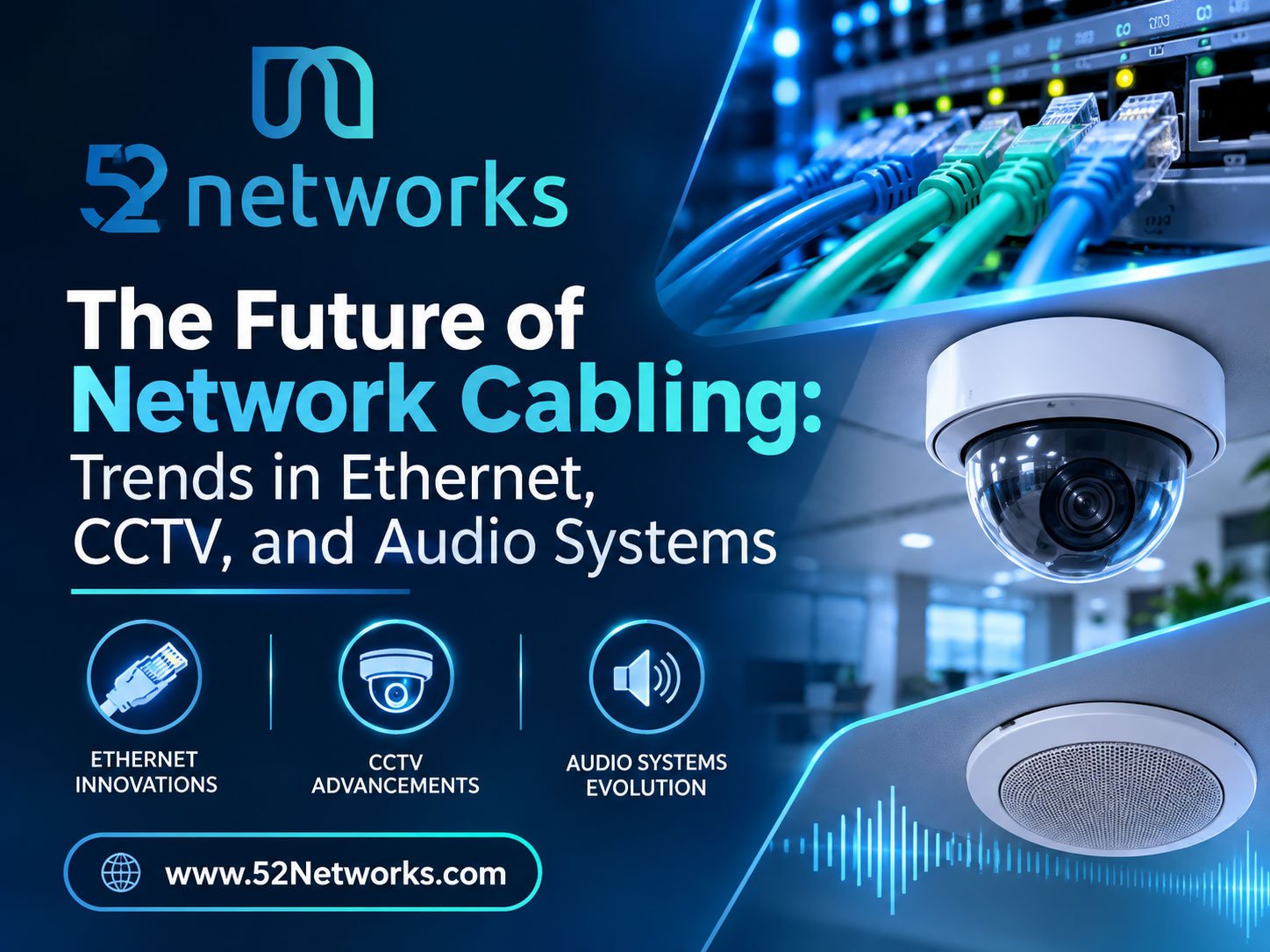
The Future of Network Cabling: Trends in Ethernet, CCTV, and Audio Systems
Network cabling is becoming more important as homes, offices, commercial buildings, and industrial facilities adopt smarter technologies. From high-speed Ethernet connections to IP security cameras and network-based audio systems, modern infrastructure depends on reliable cabling to transfer data, deliver power, and connect devices.
Although wireless technology continues to grow, physical network cables remain essential for stable performance, security, and high-bandwidth applications. As technology advances, network cabling is evolving to support faster speeds, smarter devices, and more connected environments.
Let’s explore the major trends shaping the future of Ethernet, CCTV, and audio cabling.
1. Faster Ethernet Speeds and Multi-Gigabit Networks
One of the biggest trends in network cabling is the growing demand for faster Ethernet connections. Traditional Gigabit Ethernet is still widely used, but businesses increasingly need 2.5Gbps, 5Gbps, and 10Gbps connectivity.
These faster connections support cloud applications, large file transfers, high-resolution video, network storage, and modern wireless access points.
Cat6 and Cat6A cables are becoming popular choices for new installations. Cat6 provides excellent performance for many home and business networks, while Cat6A supports 10Gbps Ethernet over a full 100-meter channel when properly installed.
Fiber optic cabling is also gaining importance in environments requiring higher bandwidth or longer-distance connections.
2. Power over Ethernet (PoE) Is Expanding
Power over Ethernet is changing how network devices are installed. Instead of requiring separate power and data connections, PoE allows compatible devices to receive both through one Ethernet cable.
Common PoE applications include:
- IP security cameras
- Wireless access points
- VoIP phones
- Network access control systems
- Smart building sensors
Newer PoE standards support higher power levels, making it possible to connect more demanding devices.
This reduces the need for separate electrical outlets and can simplify installation. However, cable quality, conductor material, cable-bundle size, and power requirements must be considered to maintain safe and reliable operation.
3. The Growth of IP CCTV and Smart Security Systems
Traditional analog CCTV systems are increasingly being supplemented or replaced by IP-based surveillance systems.
IP cameras connect to network infrastructure and transmit video over Ethernet or fiber-based networks. Many modern cameras support high-resolution video, remote monitoring, motion detection, and intelligent analytics.
As surveillance systems become more advanced, network infrastructure must handle greater bandwidth and storage requirements.
Cat6 Ethernet cable is a practical option for many IP camera installations, while Cat6A may be appropriate for demanding networks or installations requiring additional capacity.
PoE-enabled cameras also make installation easier because one cable can provide both power and network connectivity.
4. Audio Systems Are Moving Toward Network Connectivity
Audio technology is also becoming more connected. Traditional analog audio wiring is increasingly being complemented by network-based audio systems.
Audio over IP (AoIP) allows digital audio signals to travel across Ethernet networks. This technology is used in offices, conference rooms, educational facilities, broadcast environments, and commercial sound systems.
Network-based audio can simplify equipment connections and make it easier to manage multiple speakers, microphones, and audio devices.
Protocols such as Dante and AES67 support networked audio applications. Proper network design, compatible equipment, bandwidth planning, and latency management are important for reliable performance.
5. Fiber Optic Cabling Will Play a Bigger Role
Fiber optic cabling is becoming increasingly important as network bandwidth requirements grow.
Unlike copper Ethernet cable, fiber transmits data using light. It supports high bandwidth and long-distance connections while being resistant to electromagnetic interference.
Common applications include:
- Data center connections
- Building-to-building links
- Network backbone infrastructure
- High-speed server connections
- Large commercial installations
Fiber is not necessarily a replacement for every copper cable. Ethernet copper remains useful for connecting devices such as computers, access points, and IP cameras. Many modern networks combine fiber backbones with copper connections at the device level.
6. Smart Buildings and Integrated Systems
Smart buildings are increasing the demand for structured cabling that connects multiple technologies through a coordinated network.
Modern buildings may use a shared infrastructure for security cameras, access control, wireless access points, environmental sensors, lighting controls, and communication systems.
This integration can simplify management and improve operational efficiency.
However, network designers must consider bandwidth, power requirements, network segmentation, cybersecurity, and future expansion. Properly designed structured cabling provides a foundation for adding new technologies without repeatedly rebuilding the entire network.
7. Better Cable Management and Professional Installation
As network systems become more complex, professional cable management is becoming increasingly important.
Poorly organized cabling can make troubleshooting difficult, restrict airflow, and increase maintenance time. Modern installations increasingly use organized network racks, patch panels, cable managers, labeled connections, and proper testing procedures.
Installers must also select appropriate cable categories, jacket ratings, conductor materials, and connectors for each application.
In the United States, cable installation should follow applicable NEC requirements, local building codes, and relevant industry standards.
8. Planning for Future Network Requirements
Future-ready cabling is not simply about purchasing the highest-category cable available. It involves understanding current equipment, expected bandwidth needs, installation distances, PoE requirements, and future technology plans.
For many new installations, Cat6 offers an excellent balance of performance and cost. Cat6A is a strong option for 10Gbps copper connections, while fiber is suitable for high-bandwidth backbone and long-distance applications.
Planning extra pathway capacity and leaving room for future equipment can also reduce upgrade costs.
Final Thoughts
The future of network cabling is moving toward faster Ethernet, intelligent IP surveillance, network-based audio, and integrated smart building systems.
Although wireless technology continues to expand, reliable physical cabling remains the foundation of modern communication infrastructure.
Businesses and property owners who invest in quality Ethernet, fiber optic, CCTV, and audio cabling today can build networks that are easier to maintain, expand, and upgrade as technology continues to evolve.
Related Projects
In the world of network infrastructure, the choice of cabling can have a significant impact on the safety, efficiency, and overall performance of a system. Among the various categories of network cables, Cat6 plenum and Cat6 riser cables are two popular options, each with distinct features and intended uses. The...
Read More

blogOctober 9, 2026
What Ethernet Cable Do I Need for 1Gbps, 2.5Gbps, 5Gbps and 10Gbps?
Choosing the right Ethernet cable can make a big difference when you are building or upgrading a home, office, gaming setup, or network infrastructure. Ethernet cables may look similar, but different categories are...
blogOctober 13, 2026
CMR vs CMP Cable: Which Ethernet Cable Is Right for Your Building?
Choosing the right Ethernet cable for a building involves more than selecting Cat5e, Cat6, or Cat6A. You also need to consider where the cable will be installed and which fire-safety rating is required. Two common ratings in...
blogOctober 13, 2026