CMR vs CMP Cable: Which Ethernet Cable Is Right for Your Building?

Choosing the right Ethernet cable for a building involves more than selecting Cat5e, Cat6, or Cat6A. You also need to consider where the cable will be installed and which fire-safety rating is required. Two common ratings in U.S. commercial cabling are CMR and CMP.

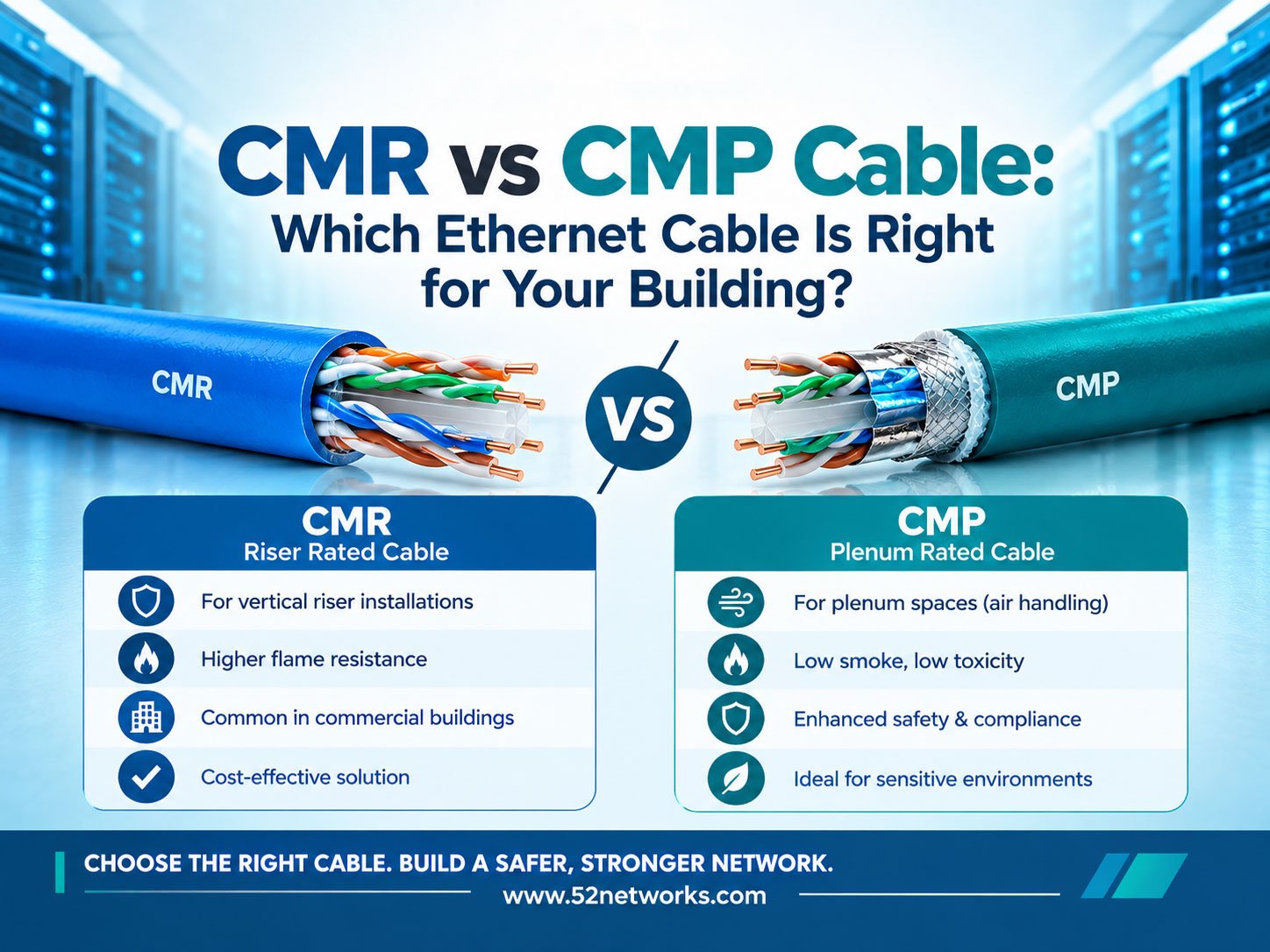
Although both cable types are used in structured network installations, they are designed for different environments. CMR is commonly known as riser-rated cable, while CMP is plenum-rated cable designed to meet more stringent flame-spread and smoke-production requirements.

Understanding the differences between CMR and CMP can help you choose suitable cabling for your building, avoid unnecessary costs, and support compliance with applicable electrical and building codes.

What Is CMR Ethernet Cable?

CMR stands for Communications Multipurpose Cable, Riser. It is designed for certain vertical installations, such as cable runs between floors through riser spaces, where the applicable codes permit its use.

Riser-rated cable must meet specific flame-propagation requirements intended to reduce the risk of fire spreading vertically through a building’s cable pathways.

CMR Ethernet cable is available in several performance categories, including Cat5e, Cat6, and Cat6A. The CMR designation relates to the cable’s fire rating, not its data-transfer speed.

For example, Cat6 CMR and Cat6 CMP may have similar Ethernet performance specifications if their other construction characteristics are comparable. Their primary distinction is the environment for which their fire ratings are intended.

What Is CMP Ethernet Cable?

CMP stands for Communications Multipurpose Cable, Plenum. It is designed for use in qualifying plenum spaces where the applicable code requires this rating.

Plenum spaces are areas used for environmental air circulation as part of a building’s heating, ventilation, and air-conditioning system. Certain spaces above suspended ceilings or beneath raised floors may qualify, but not every ceiling cavity or raised floor is a plenum.

CMP cable must meet more stringent flame-spread and smoke-production requirements than ordinary riser-rated cable under the applicable testing standards.

This is important because smoke and combustion products can travel through air-handling spaces during a fire. Using properly rated cable helps support the building’s fire-safety design.

CMP cable is generally more expensive than comparable CMR cable because of its materials, construction, and required performance testing.

CMR vs CMP: Key Differences

FeatureCMR CableCMP Cable
Full nameCommunications Multipurpose Cable, RiserCommunications Multipurpose Cable, Plenum
Intended usePermitted riser and general cable routesQualifying plenum spaces where required
Fire performanceDesigned to limit vertical flame propagationMeets more stringent plenum flame-spread and smoke requirements
Typical costUsually lowerUsually higher
Common applicationsCertain vertical runs between floorsCertain air-handling ceiling or raised-floor spaces
Ethernet speedDepends on cable categoryDepends on cable category
Can replace the other?Not in every locationMay be permitted in some locations requiring less restrictive ratings

The exact permitted use depends on the installation route, applicable code, cable listing, and local requirements.

1. Fire Safety and Building Requirements

The most important difference between CMR and CMP is their fire-performance rating.

CMR cable is intended for certain riser applications where the cable must meet applicable flame-propagation requirements. CMP cable is tested to more stringent requirements for qualifying plenum spaces.

A cable’s category, such as Cat6, does not determine whether it is suitable for a particular building space. The fire rating must be checked separately.

In the United States, the National Electrical Code (NEC), local amendments, and the authority having jurisdiction (AHJ) can affect which cable types are permitted.

Before installation, confirm whether the cable route passes through a plenum, riser, or another type of space. If the classification is unclear, consult a qualified installer or local code authority.

2. Where Should You Use CMR Cable?

CMR cable is commonly used for approved vertical network runs between floors in commercial buildings and other locations where a riser rating is permitted.

For example, an office building may require Ethernet cables to travel from a network room on the first floor to workstations or access points on upper floors. If the route and applicable code allow riser-rated cable, CMR may be a suitable option.

CMR can also be used in certain other locations where its listing is permitted. However, it should not automatically be treated as suitable for every concealed space or cable pathway.

Always check the installation requirements rather than assuming that any cable hidden above a ceiling or inside a wall can use a CMR rating.

3. Where Should You Use CMP Cable?

CMP cable is intended for qualifying plenum spaces where this rating is required.

These locations may include certain suspended-ceiling cavities or raised-floor spaces used to circulate conditioned air. Because the space can distribute smoke and combustion products, the required cable rating is particularly important.

CMP cable is frequently specified in commercial offices, schools, healthcare facilities, and other buildings where network cabling passes through designated air-handling spaces.

However, the presence of a suspended ceiling alone does not mean CMP cable is required. The actual function of the space and applicable code determine the appropriate rating.

4. Cost Differences Between CMR and CMP

CMR cable is generally more affordable than CMP cable of a comparable category and construction.

CMP cable usually costs more because it must meet more demanding flame-spread and smoke-performance criteria. The price difference depends on the manufacturer, cable category, conductor material, shielding, and quantity purchased.

For a large building project, this difference can significantly affect the overall cabling budget.

However, cost should not be the only consideration. Using a cable with an unsuitable rating may lead to compliance issues and costly replacement work.

The best approach is to determine the required fire rating first, then compare suitable products based on price, performance, and installation requirements.

5. Does CMR or CMP Affect Ethernet Speed?

No. The CMR or CMP designation primarily describes the cable’s fire rating, not its Ethernet speed.

Network performance depends on factors such as the cable category, length, connectors, termination quality, and connected equipment.

For example, Cat6 CMR and Cat6 CMP cables can both support Gigabit Ethernet when properly specified and installed. Their suitability for 10Gbps or other speeds depends on the cable category and the installation conditions, not simply on whether the jacket says CMR or CMP.

When purchasing Ethernet cable, check both specifications: the performance category and the required fire rating.

6. Can You Use CMP Instead of CMR?

CMP-rated cable may be acceptable in locations where CMR cable is permitted, provided the product is suitable and the applicable code allows it.

However, CMP is often more expensive, so using it throughout a building may increase costs without providing a necessary benefit.

CMR cable should not be substituted for CMP cable in a space that requires a CMP rating unless an applicable code provision explicitly permits the proposed alternative.

When planning a commercial installation, identify each cable route and select the rating required for that specific environment.

Final Verdict

CMR and CMP Ethernet cables serve different installation needs. CMR is intended for qualifying riser applications, while CMP is designed for qualifying plenum spaces that require more stringent flame-spread and smoke-performance characteristics.

Choose CMP when the applicable code requires plenum-rated cable. Choose CMR where riser-rated cable is permitted and appropriate.

Neither option is automatically better for every building. The right choice depends on the cable pathway, building design, product listing, and applicable local requirements.

By checking the required rating before purchasing, you can make a safer, more cost-effective decision and build a reliable network infrastructure for your property.

Leave a Reply

Your email address will not be published. Required fields are marked *


Related Projects