

Plenum vs Riser Cable: What’s the Difference?
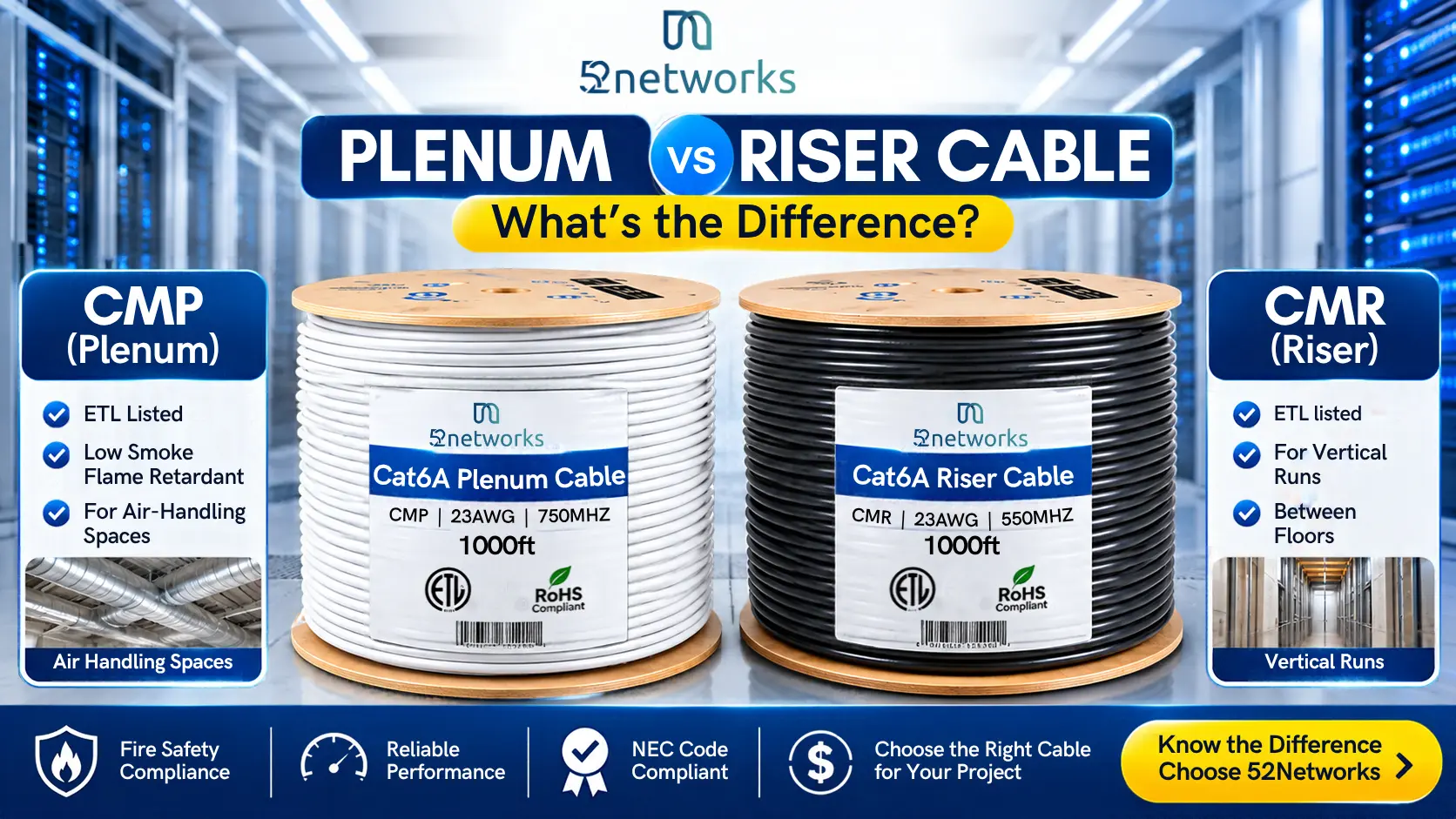
Plenum cable (CMP) is rated for air-handling spaces like open return-air ceilings. Riser cable (CMR) is rated for vertical runs between floors. Plenum has the higher fire rating and costs more. It can replace riser cable anywhere, but riser cable can never replace plenum.
Choosing the wrong one costs far more than the price gap between the cables. A failed inspection can mean pulling out and replacing every cable you installed. This guide explains the NEC fire code basics, where each rating is required, and what a wrong choice really costs.
Quick answer: Use CMP in plenum spaces (open return-air ceilings, air-handling areas). Use CMR (or CMP) in vertical shafts and floor-to-floor runs. Use CM/CMG only for horizontal runs inside a single floor, outside plenum spaces. Always confirm with your local inspector, because local codes and NEC editions vary.
What Is Plenum Cable (CMP)?
A plenum is a space used to move air as part of a building’s heating and cooling system, such as the area above a drop ceiling that serves as a return-air path. If a fire starts there, smoke can travel through the whole building quickly.
Plenum cable (marked CMP) is built to limit flame spread and smoke. It uses a low-smoke, flame-retardant jacket, and most plenum cable uses fluoropolymer (FEP) insulation. It is tested to UL 910 (also known as the Steiner tunnel test, equivalent to NFPA 262), the toughest fire test for communications cable.
What Is Riser Cable (CMR)?
Riser cable (marked CMR) is built for vertical runs that pass from floor to floor through shafts, chases, and penetrations. Its job is to keep fire from climbing the building through the cable path. It is tested to UL 1666, a vertical shaft flame test.
CMR has a lower fire rating than CMP and is less strict on smoke, so it is not allowed in plenum spaces.
The NEC Cable Hierarchy
NEC Article 800 covers communications cable. Cable types rank from the highest fire resistance to the lowest:
| Rating | Name | Fire test | Typical use |
|---|---|---|---|
| CMP | Plenum | UL 910 / NFPA 262 | Air-handling spaces, and anywhere lower ratings are allowed |
| CMR | Riser | UL 1666 | Vertical runs between floors, and general use |
| CMG / CM | General purpose | UL 1685 (vertical tray) | Horizontal runs within one floor, non-plenum |
| CMX | Limited use | VW-1 | Residential, limited conditions |
The substitution rule: a higher-rated cable can replace a lower-rated one, but never the reverse.
- CMP can be used where CMR, CM, or CMX is permitted.
- CMR can be used where CM or CMX is permitted.
- CMR cannot go in a plenum, and CM cannot go in a plenum or a riser.
Where Each Rating Is Required
| Installation area | Minimum rating | Why |
|---|---|---|
| Open return-air ceiling or other environmental air space | CMP | Smoke can spread through the air system (NEC 300.22) |
| Raised floor used for air movement | CMP | Same air-handling reason |
| Vertical shaft or run through more than one floor | CMR | Stops fire climbing between floors (NEC Article 800, with 300.21) |
| Horizontal run on one floor, not in a plenum | CM / CMG | Lower fire risk |
| Single-family home, limited use | CMX | Residential allowance |
Common situations that trip people up
- Drop ceilings are not always plenum spaces. A ceiling with ducted return air is usually not a plenum. An open return above a drop ceiling is. Check the mechanical drawings and ask the inspector.
- Mixed routes. If a run starts in a riser and then crosses a plenum ceiling, the plenum part needs CMP. Many installers use CMP for the whole run to avoid mistakes.
- Floor penetrations. Any cable passing through a floor needs at least CMR, even if both floors are non-plenum. Fire-stopping at each penetration is a separate requirement.
- Exceptions exist. Some cases, such as fireproof shafts or metal raceway, allow other ratings. Treat these as exceptions to confirm, not as a plan.
- Edition and local rules. Article numbers moved between NEC editions, and local jurisdictions can add rules. The inspector (AHJ) has the final word.
Plenum vs Riser Cable: Key Differences
| Plenum (CMP) | Riser (CMR) | |
|---|---|---|
| Fire rating | Highest | Middle |
| Smoke output | Lowest | Higher |
| Test | UL 910 / NFPA 262 | UL 1666 |
| Jacket and insulation | Low-smoke compound, often FEP | Standard flame-retardant PVC |
| Allowed in plenum | Yes | No |
| Allowed in risers | Yes | Yes |
| Cost | Higher | Lower |
Neither rating changes data speed. A Cat6 or Cat6A cable performs the same in either jacket. You are paying for fire safety and code compliance.
What Does Choosing Wrong Cost?
There are two ways to get it wrong, and one is much more expensive.
Mistake 1: Riser cable where plenum is required (expensive)
This is the costly one. If an inspector finds CMR in a plenum space, the install fails. You may have to pull out the cable and run new CMP, then repeat testing and re-inspection. You also risk project delays, extra permits, and, if it is missed, a real safety and liability problem.
Mistake 2: Plenum cable where riser would do (small overspend)
This is legal and safe, but you pay a premium for nothing. The overspend is modest per box, which is why many jobs use CMP throughout.
Example cost comparison
Here is how the numbers compare using example listing prices at 52Networks for a 20-box job (about 20,000 ft, or 100 drops averaging 200 ft):
| Cable | Riser (CMR) per box | Plenum (CMP) per box | Cable cost, 20 boxes (CMR → CMP) |
|---|---|---|---|
| Cat6 bare copper | ~$169–$175 | ~$199 | ~$3,400–$3,500 → ~$4,000 |
| Cat6A bare copper | ~$245 | ~$290–$319 | ~$4,900 → ~$5,800–$6,400 |
What this shows:
- Plenum costs roughly 15 to 25% more per box for the same category.
- On a 20-box job, the extra cost of using plenum everywhere is about $500 to $1,500.
- Re-pulling a failed install can cost about as much as the original labor. Using our earlier model of $150 per drop, that is around $15,000 for 100 drops, plus new cable and delays. (Labor figures are planning assumptions. Get local quotes.)
So paying a small premium for CMP where there is any doubt is cheap insurance.
How to Choose: A Simple Decision Guide
- Is any part of the route in an air-handling space? Use CMP for that route.
- Does the cable go between floors? Use CMR or CMP.
- Is the route horizontal, on one floor, and clearly non-plenum? CM/CMG may be allowed, but check local rules.
- Not sure? Use CMP. It is allowed everywhere that CMR and CM are, and the extra cost is small.
- Ask the inspector early. A five-minute call before the order costs nothing.
- Check the jacket. The rating should be printed on the jacket, along with the listing mark.
- Match the listing. For commercial work, buy cable that is third-party listed (ETL or UL), not just “compliant.”
Where to Buy Plenum and Riser Cable
For bulk orders, both ratings are sold in standard 1000ft boxes. 52Networks stocks CMP and CMR bulk cable, and many of its listings state 100% solid bare copper and ETL listing. Its product pages show price, stock, and spec tables, which helps when you need paperwork for an inspector.
Plenum (CMP) bulk cable:
Riser (CMR) bulk cable:
For larger jobs, you can ask for bulk or pallet quotes. Before ordering, ask for the listing data sheet, and confirm the rating, copper content, and shielding on the spec sheet.
Frequently Asked Questions
What is the main difference between plenum and riser cable?
Plenum cable (CMP) has a higher fire rating with low smoke output and is allowed in air-handling spaces. Riser cable (CMR) is for vertical runs between floors and is not allowed in plenums.
Can I use riser cable in a plenum space?
No. Riser cable does not meet the plenum fire and smoke test. It will fail inspection in a plenum space.
Can I use plenum cable instead of riser cable?
Yes. Plenum cable can be used wherever riser cable is allowed. Many installers use CMP everywhere for simplicity.
Where is riser cable required?
In vertical runs that pass through more than one floor, such as shafts and chases, with fire-stopping at the penetrations.
Is plenum cable faster than riser cable?
No. The jacket affects fire and smoke behavior, not speed.
How much more does plenum cable cost than riser?
About 15 to 25% more per box for the same category, based on example bulk listing prices. The gap varies by supplier.
Do I always need plenum cable above a drop ceiling?
No. Only if the space is used for environmental air, such as an open return-air plenum. A ceiling with ducted return air usually is not. Check the plans and ask the inspector.
Final Word
The rule is simple: CMP for air-handling spaces, CMR for vertical runs, and never go lower than the space requires. When in doubt, plenum is the safer and usually cheaper choice compared with the cost of a failed inspection.
Prices were collected from public listings in November 2026 and may have changed. Cable code rules vary by NEC edition and local jurisdiction. Confirm requirements with your local authority before you order or install.
Related Projects
Read More
UncategorizedNovember 19, 2026
How to Build a Reliable Network Infrastructure for a Small Business
Plenum vs Riser Cable: What’s the Difference?
Plenum cable (CMP) is rated for air-handling spaces like open return-air ceilings. Riser cable (CMR) is rated for vertical runs between floors. Plenum has the higher fire rating and costs more. It can replace riser cable anywhere, but riser cable can never...
UncategorizedNovember 19, 2026