Choosing the right Ethernet cable can make a big difference when you are building or upgrading a home, office, gaming setup, or network infrastructure. Ethernet cables may look similar, but different categories are designed to handle different bandwidths, frequencies, and networking requirements.

If you are wondering whether you need Cat5e, Cat6, or Cat6A for 1Gbps, 2.5Gbps, 5Gbps, or 10Gbps, the good news is that the choice is relatively simple.

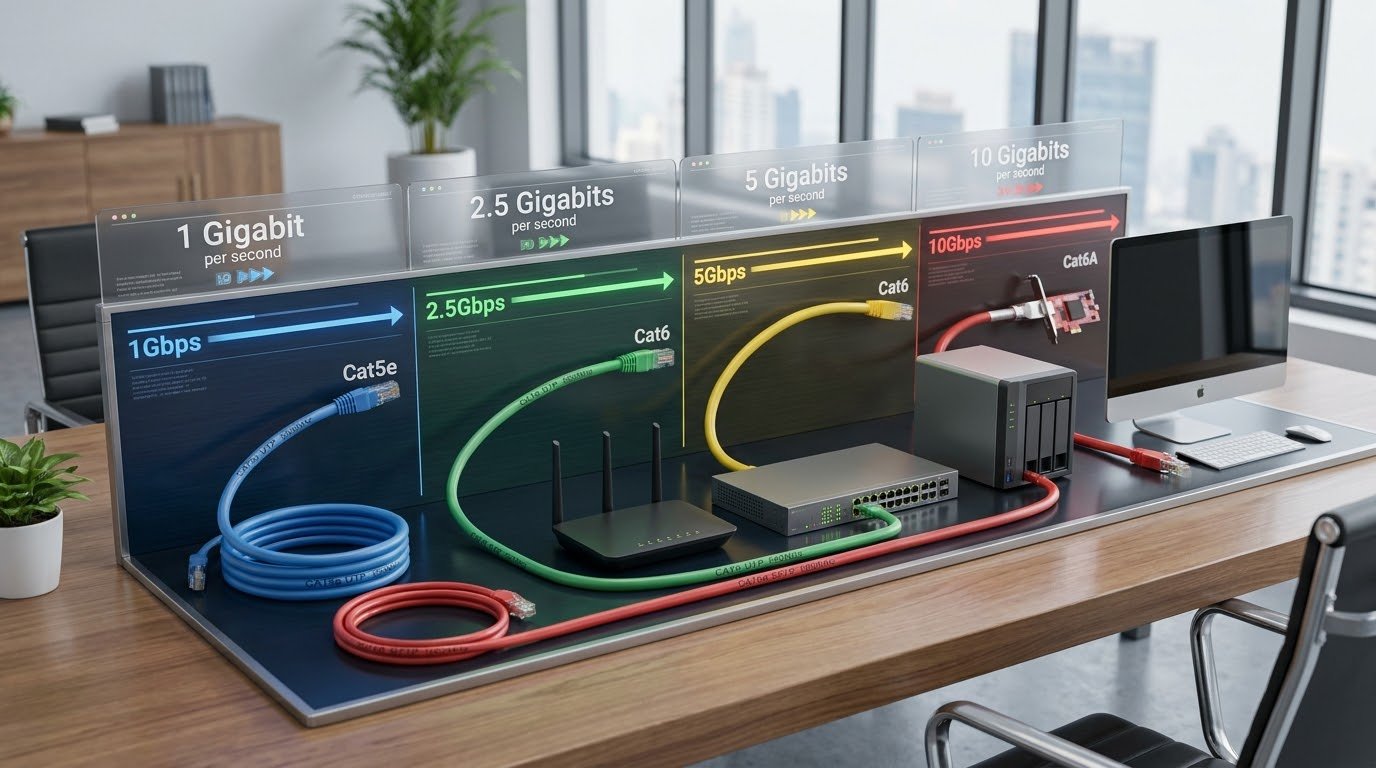
For most modern networks, Cat5e is enough for 1Gbps, Cat6 is a strong choice for 2.5Gbps and 5Gbps, and Cat6A is the preferred option for 10Gbps over standard full-distance copper cabling.

Quick Answer

Network SpeedRecommended CableTypical Use
1GbpsCat5e or Cat6Home internet, gaming, office networks
2.5GbpsCat6Multi-gig home and office networks
5GbpsCat6 or Cat6AHigh-performance networks
10GbpsCat6AHigh-speed offices, servers, NAS, data-intensive networks

However, cable category is only one part of the equation. Your router, switch, network adapter, connectors, cable length, and installation quality also affect the final performance.

What Does Gbps Mean?

Gbps stands for gigabits per second and describes the speed at which data can move across a network connection.

A 1Gbps Ethernet connection can theoretically transfer data at up to 1 gigabit per second. A 10Gbps connection has ten times the theoretical bandwidth.

Actual file-transfer speeds are usually lower because of protocol overhead, hardware limitations, network traffic, and other factors.

This is why simply buying a faster cable does not automatically make your network faster. Every major component in the connection needs to support the desired speed.

1Gbps: Cat5e Is Usually Enough

For a standard 1Gbps network, Cat5e is generally all you need.

Cat5e cable is widely used in homes, offices, security systems, and general-purpose Ethernet installations. It is designed for Gigabit Ethernet and can support 1Gbps connections over standard structured-cabling distances when properly installed.

If your internet plan is 1Gbps or your network equipment has Gigabit Ethernet ports, there is usually little reason to replace good-quality Cat5e cable simply because newer categories exist.

Choose Cat6 instead if you are installing new cable and the price difference is small. It provides additional performance headroom and is a practical choice for future upgrades.

2.5Gbps: Cat6 Is a Great Choice

2.5Gbps Ethernet has become increasingly useful for modern homes and small businesses.

It can be particularly valuable when you have multi-gigabit internet, fast Wi-Fi access points, a NAS, or several devices transferring large files across your local network.

Cat5e can support 2.5Gbps under appropriate conditions, so an existing Cat5e installation may not need to be replaced. However, for a new installation, Cat6 is an excellent choice.

Cat6 provides more bandwidth and better crosstalk performance than Cat5e, giving you additional margin for modern multi-gigabit networking.

5Gbps: Cat6 or Cat6A

For 5Gbps networking, Cat6 is a practical option, especially for typical home and office installations.

Existing Cat5e cabling may also support 5Gbps under suitable conditions, but performance depends on cable quality, length, installation, and the surrounding environment.

If you are installing new cable and want greater long-term flexibility, Cat6A is worth considering. It provides additional performance capability and stronger resistance to interference and crosstalk.

For demanding environments or installations where future upgrades are important, Cat6A can be a sensible investment.

10Gbps: Choose Cat6A

When you need 10Gbps Ethernet, Cat6A is the straightforward choice for new full-distance copper installations.

Cat6A is rated to 500 MHz and is designed to provide reliable 10Gbps performance over the commonly referenced 100-meter structured-cabling channel.

Cat6 can also support 10Gbps over shorter distances under appropriate conditions, but its performance depends more heavily on the installation environment and cable length.

For a new office, server room, NAS network, or high-performance infrastructure where 10Gbps is a serious requirement, Cat6A provides a better long-term solution.

Cable Category Is Not the Only Factor

Buying the correct cable does not guarantee the desired speed.

Your network needs compatible equipment from end to end. For example, if you want a 10Gbps connection, your router or switch, computer network adapter, and other active equipment must also support 10Gbps.

A 10Gbps cable connected to a 1Gbps network port will still operate at 1Gbps.

The same principle applies to 2.5Gbps and 5Gbps networks. Check the specifications of your router, switch, motherboard, network adapter, access point, and other connected devices.

Cable Length Matters

Ethernet performance can also be affected by cable length.

The commonly referenced maximum for structured copper Ethernet channels is 100 meters, including the permanent link and patching components. Shorter connections generally provide more flexibility, particularly when using higher-speed standards.

If you are running cable across a large building or between network closets, proper structured-cabling design becomes increasingly important.

Solid Copper vs. CCA

When purchasing Ethernet cable, look for quality copper conductors and avoid cables marketed as CCA, or copper-clad aluminum, for permanent structured cabling.

CCA cables are not equivalent to solid copper Ethernet cabling and can present additional concerns, particularly with Power over Ethernet (PoE), resistance, durability, and compliance with structured-cabling requirements.

For professional installations, quality and standards compliance are more important than simply choosing the cheapest cable.

What About Cat7 and Cat8?

Cat7 and Cat8 cables are often marketed as faster or better alternatives, but they are not automatically the best choice for every network.

For most homes and offices, Cat6 or Cat6A is more than sufficient.

Cat8 is intended for specialized high-speed applications and shorter-distance environments, particularly in data centers. Buying Cat8 for a typical home Gigabit or 2.5Gbps network usually provides little practical benefit.

Final Recommendation

The right Ethernet cable depends on your current equipment and future plans.

  • 1Gbps: Cat5e is sufficient; Cat6 is a good upgrade for new installations.
  • 2.5Gbps: Cat5e may work, but Cat6 is a strong choice for new cabling.
  • 5Gbps: Cat6 is practical, while Cat6A offers additional headroom.
  • 10Gbps: Cat6A is the preferred choice for new full-distance copper installations.

If you are replacing existing cabling, do not upgrade just because a higher category exists. First check your actual network requirements, cable condition, installation quality, and equipment capabilities.

For most modern home and business networks, Cat6 offers an excellent balance of performance, cost, and future flexibility, while Cat6A is the better choice when 10Gbps performance and long-term infrastructure planning are priorities.

Leave a Reply

Your email address will not be published. Required fields are marked *


Related Projects